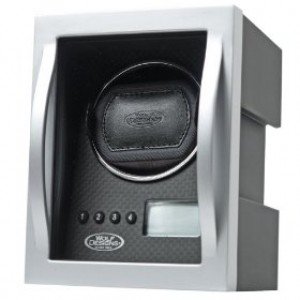
Module Double Watch Rotator 2.0 is the hottest product for the person who has everything and aspires for more. The 2.0 makes an idealisti associate for self-winding watches because it simulates the wrist action, rotating the timepiece as if it were being worn and keeps it wound and ready to wear at a moment’s notice. It provides 600 rotations per day on an intermittent basis within a six-hour time span, which is followed by an 18-hour ‘sleep’ phase. This allows the mainspring an prospect to release it is stored energy with a nominal amount of energy being spent, keeping the focus on reliability. The Module 2.0 Double Watch Rotator features shiny chrome hardware, smooth leather, and a top compartment with storage for two watches and a handy travel case that holds a single watch. The unit is notably quieter than other watch rotators and operates on AC power or D-cell batteries. The 2.0 Double Rotator is a showpiece just as striking as the watches it winds.
The Wolf Designs Story

Our story, the ‘Wolf Story,’ is something we take outstanding pride in sharing. Not just because the business bears our family name, but also because this is our family. This is what the Wolf family has done for five generations.
BEGINNINGS ON FAIRY TALE ROAD
The Wolf Designs bequest begins like the Deutsche Marchensrasse (Fairytale Road) in Hanau, Germany in 1834. It was in Hanau that Philip Wolf I, a silversmith by trade, begun to fabricate leather-covered making something publicly available cases for his silver products. His rationale was clear: it is only logical to protect one’s investment in fine silver by storing and safeguarding it in a fine quality case. Presentation and storage cases for jewelry were not unique, however, covering the case in rich leather was something that Philip I would be credited with inventing. The routine of cutting and stitching leather panels together was a laborious task. The leather was fastened onto the frame and inspected with care to assure that each piece met Philip’s high standards.
INCREASING VALUE
In 1836, Philip was syndication more formally presenting something and jewelry boxes than silver so he moved away from making silver and concentrated on honing his attainments making leather boxes. His business continued to grow as a heap of local silver and goldsmiths came upon that their productions held more outstanding value when offered in a case made by Philip Wolf.
Philip Wolf II was born in 1869. He would come to take over the family business, but only after years of apprenticeship. By 1905, the Wolf family had immigrated to Malmö, Sweden. Visiting the region on holiday, Philip II met a beauteous woman. He decisive he liked the country and chose to stay.
SEEING IT THROUGH
If there were any individual who could personify the steadfast determination of the Wolf family, it would be a woman named Ida Wilhemina. Born of Swedish dissent in 1889, she married Philip II in 1910. Ida was known for her extraordinary resourcefulness, courage, and drive to see her family and the family business persevere, even though difficult circumstances. In 1926, Philip Wolf II fell ill with a lung ailment, leaving him unable to work and support his family. Ida Wilhemina Wolf was faced with the probability of looking at the family business, and their sole means of support, dwindle away. She could not let this happen. After with great success taking over the management of the Wolf business, she likewise took on sales. Ida understood that Wolf Designs necessitated it is clients and clients necessitated Wolf Designs, so she set off on the road. Though her means of transportation were vastly dissimilar from that of today’s sales representatives, the occupation she performed was not much different. Her essential methods of travel were horse-drawn cart and railroad car, stopping in each city, town, and village to trade Wolf Designs jewel cases. To conserve cash she would stay in train stations, renting a blanket for 0.50 krona per night, and on occasion receive an invitation into the home of a customer.
THE FAMILY’S BUSINESS
During this time, Mrs. Wolf looked to her sons Philip III and Ernst. They were both in their early teens when they begun working full-time for the company. Though this was not strange for young men of this time, it was distinctive that they were without delay placed in roles of significant responsibility. Mrs. Wolf would be gone for up to three months at a time, carrying one suitcase for personal items and another for sample products. Once each week she would mail her buy orders to the factory, where production manager Gerda Ridell would stand at the door awaiting their delivery.
FROM ‘SLOW AND STEADY’ TO ‘FAST FLOW’
The reins were passed to Philip III in 1936, for the duration of a international depression. Due to the cautious nature of the Wolf family and Sweden’s neutrality for the duration of the war, the Company was competent to export significant amounts of product and get enjoyment from a stable home market all around the Depression and World War II. Throughout his tenure, Philip III was determined to establish Wolf Designs as a benchmark for professionalism and sound business practices. He promptly introduced ‘fast-flow’ production methods, which dramatically bettered developing efficiency.
GROWING UP AND OUT
At the same time, Wolf Designs imposed new distribution and sales programs that were managed directly by the company. This also proved successful and resulted in extraordinary growth. In 1939, Philip III purchased a five-story building in the center of Malmö to handle the speedily expanding operations. This building housed all distinct features of the business: manufacturing, sales, distribution, administration, and 200 highly devoted employees. The company remained in this building for more than twenty years, until the early 1960s. At that time, they moved to a new 80,000 square foot building, designed and built just for Wolf Designs to hold progressed offices and a labor strength expanding to more than 350 employees. This facility developed items for merchants who sells goods at retail and clients allround Europe.
A FAMILY WITH VISION, A COMPANY WITH HEART
Beyond Philip III’s business acumen, Wolf Designs became known as a company with a outstanding social conscience, with programs to support the company’s employees, community, and environment. Philip III ofttimes loaned cash to staff members to support them buy houses. He knew that a comfortable and stable workforce would likewise be more loyal and productive. Philip III cared deeply when it comes to the environment. What started as a casual interest shortly blossomed into his lifelong dedication. By 1947, he had built the family business to such a stable position that he could crusade to South America to volunteer his time, intellect, and energy to sustaining the environment. He also gave speeches allround Sweden to lobby the government versus soil erosion, while still continuing to formulate his family business. Philip IV was given the edict to go to the UK and establish the business there. His brother Richard, a professional ballet dancer, stayed in Sweden with his father to run the parent company.
FROM A SUITCASE TO SELFRIDGE’S
In 1961, Philip IV arrived in London armed only with a suitcase and samples. He without delay begun visiting and selling to companies like Ronson and Timex. At the time, Ronson was the greatest cigarette lighter manufacturer in the world. They had planned a launch for a new women’s lighter, and a Wolf Designs case would be the launch vehicle. The jewelry case business likewise flourished with clients like Harrods and Selfridge’s stores in London. The Company even had it is own ‘store-within-a-store’ at Selfridge’s, staffed by Wolf Designs’ workers and with a huge area devoted to it is products. Customers marveled at the finely crafted leather-covered boxes. Once Philip IV had conventional Wolf Designs all around the UK, the family decisive to move there. In the spring of 1964, they moved into an office on highly fashionable Old Bond Street in London.
WOLF DESIGNS TAKES OFF!
In 1968 the Company decisive to set up a production facility in the UK. Philip IV chosen a website in South Wales, well known for it is factory buildings and the availability of it is labor. The factory opened in the spring of 1968 and was an prompt success. Products were sold all over the UK as well as in numerous international markets. Often, Philip IV had to travel to the factory, which was 250 miles from the sales office in London. This caused difficulties and put a lot of pressure on him. Fortunately, Philip received his pilot’s license and begun to commute by air. Soon, clients were more than willing to join him, and some visits were made from the UK to the Swedish factory, as well as to France, Holland and other countries.
THE TRADITION CONTINUES
Under the wing of Philip IV, Wolf Designs continued to fly high. The winds were right for modify and with the 1980s came a amount of time of substantial adjustment and transition. In May of 1980, while sitting at the kitchen table in the Wolf home in South London, Ida Wilhemina passed away from a heart attack. Her funeral was kept in Malmö and attended by hundreds. In 1988, Simon Philip Wolf V left the UK at his father’s direction to open a US subsidiary in Chicago. He would labour for close to a decade to build the Wolf Designs brand in the North American market, at long last succeeding in the mid-1990s when annual growth begun to exceed seventy percent. In the midst of these substantial corporate changes and the accompanying growth of Wolf Designs, Philip III followed Ida and passed away in 1992. If Ida was the heart of Wolf Designs through the 1930s, 40s and 50s, Philip III was the soul. He is fondly remembered for evolving Wolf Designs into a business that runs like a Swiss watch, while still caring for the surroundings and the people that are share of it.
Philip IV and Simon Philip V, staying unfeigned to the company philosophy, built the North American section ‘one brick at a time’, meeting personally with leading merchants who sells goods at retail in markets all over North America and establishing relationships that will stand the test of time. In 2001, Wolf Designs US celebrated the accomplishment of a fantastic milestone; this was the basi year in which the Company sold over one million leather-covered cases in North America. While this number is great, and our family is proud to have achieved this success, what matters most to all of us in the Wolf family are the unbelievable humans we have had the good fortune to portion our passion with, and will carry on to for another 175 years.
All the best,
Philip IV